A Designer’s Guide to Taming the Dice
New players sometimes finish their first game feeling like the ending came down to dice. Experienced players almost never say this — not because they roll better, but because they’ve learned the game’s central lesson:
The dice decide the ending. Good players decide how much the dice get to say.
Let me be clear about what this game is, on purpose: there’s a D10 in the box, and it has real authority. Perfect play makes you the favorite — it never makes you safe. If you want a game where the best plan always wins, this isn’t it. If you want a game where your plan decides how much the dice can hurt you — and where nobody is ever mathematically out of it — pull up a chair.
The early game hands you easy money and open ports, and it’s tempting to just connect pieces because you can. That’s the trap. The market, the sprays, the bug timing, the shape of your build, the deals you cut — that’s the actual game. Here are the six roads experienced players take. Winning strategies usually blend at least two.

ROAD 1: THE MARKET PLAYER
cash is insurance
Early in the game the market is thin and prices are strong — sell into that scarcity, then buy back as the market floods and prices sag. Cash is the game’s most flexible resource: a rich player can react to whatever the draws and rolls do — replace a stolen part, grab what just appeared, cut a deal with an opponent. A broke player has one plan and must roll well for it.
BEGINNER MISTAKE THIS PREVENTS: Ignoring the market until you need something, then paying peak prices with money you don’t have.
ROAD 2: THE HOARDER
redundancy absorbs bad luck — and denial wins games
Splitters and extra hardware let you hold more than you strictly need — and redundancy converts catastrophes into inconveniences. A stolen part hurts the player who had exactly enough; the hoarder installs the spare. Every spare part is a die roll you don’t have to make later.
But hoarding cuts deeper than defense: the supply is finite. Every part you hold is a part nobody else can have — and if you’re holding what a rival needs to finish, they cannot win without cutting a deal with you or stealing. Done deliberately, hoarding isn’t stockpiling; it’s cornering the market on someone’s win condition. In all my plays, almost nobody does this. Everyone’s too busy buying and building to notice the denial game sitting on top of the acquisition game.
The corner has a price, though, and it’s why the road is harder than it sounds: hoarding costs more cash, and the hardware has to live somewhere. On your workbench, it can be easier to steal. On your board, it eats the real estate your build needs. A big hoard is simultaneously a target and an obstruction — the game makes you feel the weight of everything you’re sitting on. If nothing goes wrong and nobody needs your hardware, the lean player beats you.
BEGINNER MISTAKE THIS PREVENTS: Building just-in-time with no slack — and never once looking at what your rivals need that you could be sitting on.
ROAD 3: THE FORTRESS BUILDER
no ports, no problems
Bugs need somewhere to land. Plan the shape of your build, not just its contents — sequence parts so vulnerable ports close up behind you. This is the purest luck management in the game: a machine with no attack points has opted out of the endgame’s most volatile subsystem entirely. The cost is constraint — fortress builds are slower, and sometimes lose races to riskier ones. But they never lose to a bug streak.
BEGINNER MISTAKE THIS PREVENTS: Connecting parts wherever they fit, leaving a build that’s all attack surface — then blaming the dice for exploiting it.
ROAD 4: THE SCHEDULER
a bug in the hand
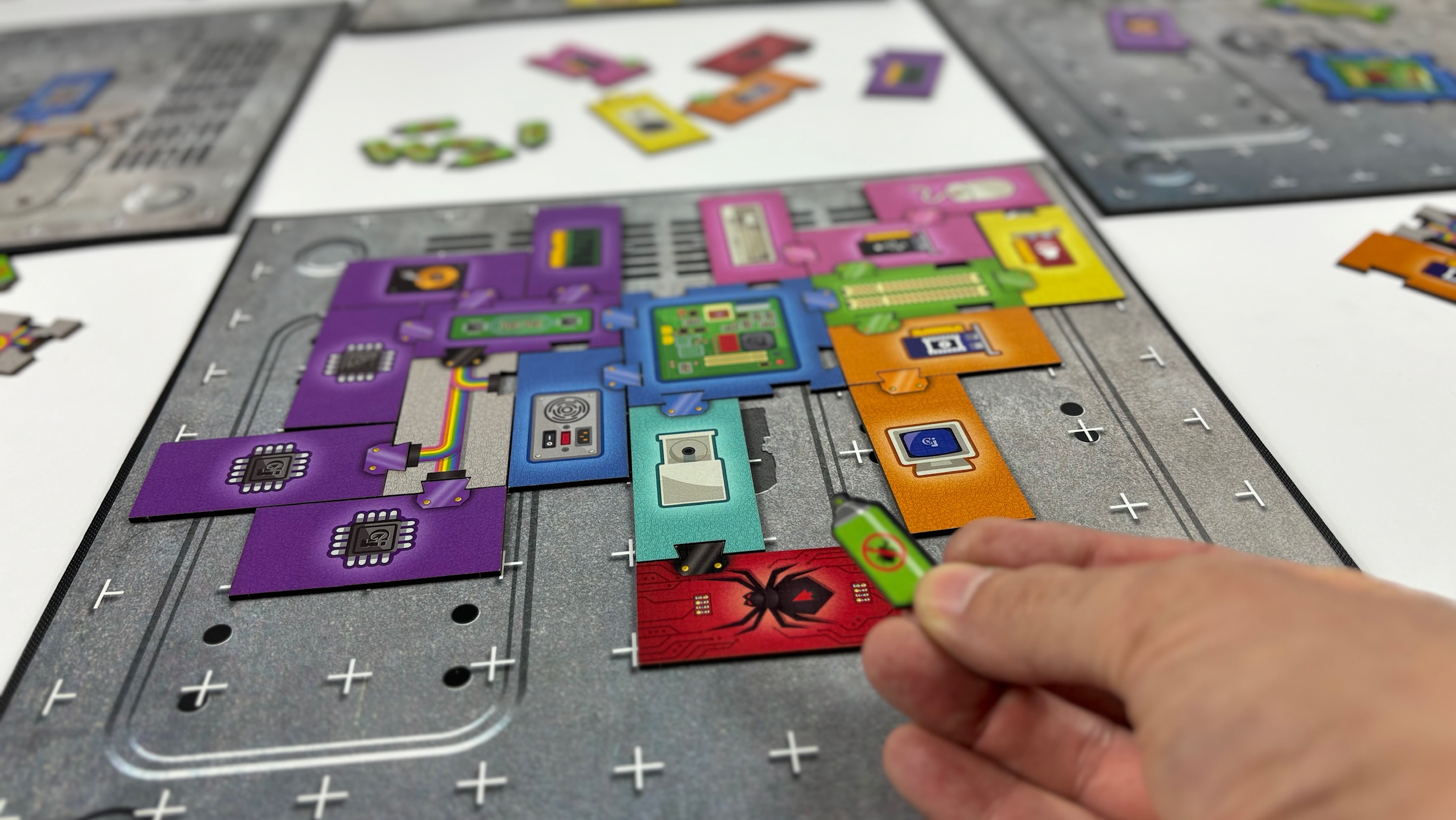
You don’t have to remove a bug right away — and sometimes you shouldn’t. A bug can block a pair of ports, or sit so it crowds out a neighboring tile — and early in the game, that’s often doing you a favor: a port a bug is covering is a port no second bug can land on, and blocked space you didn’t need yet costs you nothing. Treat it as temporary armor. Keep buying, selling, and building while opponents burn turns on removal rolls.
But the clock is real, for two reasons: eventually that bug blocks your progress — and you can’t win with a buggy computer. Every bug must come off before your software installs. So deferral isn’t skipping the removal roll; it’s scheduling it. The skill is picking the moment: early enough that a bad streak can’t cost you the race, late enough that you banked the free turns.
BEGINNER MISTAKE THIS PREVENTS: Treating every bug as a fire and paying peak price in tempo to remove it immediately — when it was quietly guarding your ports for free. (The opposite mistake is rarer but fatal: forgetting the bug has to come off at all, and rolling for your life on the final turn.)
ROAD 5: THE SPRAY & LOCK TRADER
failure is an asset
The rule most tables forget: when a removal roll fails, you gain a spray — permanently. You start with none. Removal takes 6+ on the D10, and every spray you hold adds +1 to your roll, forever. Miss once, you’re rolling at 5+. Miss again, 4+. Four straight misses is roughly a 1-in-80 event, after which you succeed on a 2 or better. The game compensates failure automatically; most frustrated tables never notice.
Sprays and locks are both tradeable assets — but their liquidity rules differ, and knowing the difference is the road:
Sprays trade or sell to other players only. The junkyard won’t buy them and won’t sell them. Hold three and roll at 3+, or sell one to a rival for cash and roll at 4+ — your future odds, priced in real time. Just remember a spray sale arms the opponent racing you to the finish.
Locks trade with players and sell back to the junkyard. A lock in hand isn’t just theft protection — it’s emergency money. The player sitting broke with one or two locks isn’t actually broke; they just haven’t noticed.
BEGINNER MISTAKE THIS PREVENTS: Treating sprays and locks as bookkeeping instead of held, tradeable positions — and never noticing the game has been quietly paying you for every failed roll.
ROAD 6: THE DEALMAKER
the other players are a market too
The junkyard isn’t the only market — the other players are one too. Parts, locks, and sprays all trade between players, and most tables forget it entirely. Need one component to finish and a rival has a spare? Everything has a price. Two players behind the leader can collude — a below-market parts deal here, a coordinated bug there — right up until one of them back-stabs the other at the finish. All of it is legal. All of it is the game.
BEGINNER MISTAKE THIS PREVENTS: Playing four separate solitaire games at one table — and never realizing the richest trading partner in the junkyard is sitting right across from you.
KNOWING WHEN TO SWITCH ROADS
The deepest games happen when players read the table. Everyone hoarding? The market is starved — sell into it. Ports you can’t close? Bank cash and watch the spray market now, not when the bug lands. Behind in the race? The risky fast build might be right. Luck management doesn’t mean luck avoidance; it means the exposure you carry into the endgame is exposure you chose, priced, and prepared for.
ABOUT THAT BUG THAT WOULDN’T DIE
Every group eventually has the story. Two things: the game was compensating you the whole time — even a 1-in-80 streak of four misses leaves you at 90% to succeed, holding four sprays for the rest of the game. And look upstream of the roll: what did you do with the easy money and open ports the early game offered? The players who engage the market, the spray trades, the bug timing, and the shape of their build are the ones whose endings never feel like dice.
Play a second game. Pick a road on turn one. The dice will still talk — but you’ll be surprised how little they have to say.
by Allan & Jared Pincus
Dream Egg Games